


Trying to get pregnant can feel exciting at first.
But when months pass without success, questions slowly begin to surface.
“Why is pregnancy not happening?”
“Is something wrong?”
“What tests do we actually need?”
For many couples struggling to conceive, one commonly recommended investigation is the HSG test.
If you have recently heard your doctor mention it, the name itself may sound intimidating.
But the truth is:
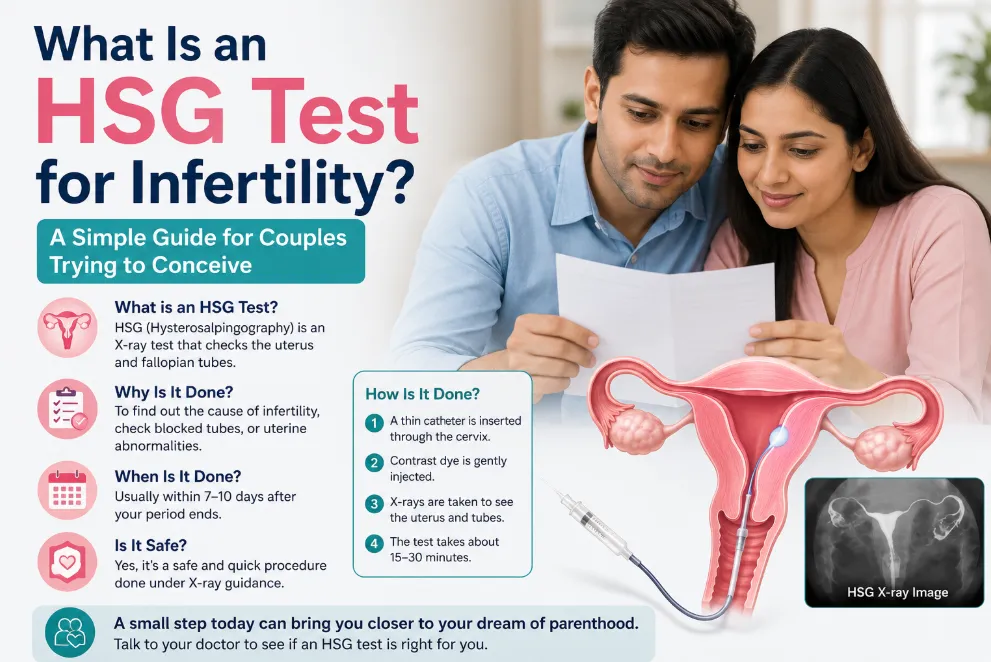
An HSG test is a simple and important diagnostic procedure that helps doctors understand whether your fallopian tubes are open and whether your uterus looks healthy for pregnancy.
For many women facing infertility, this test often becomes an important first step toward getting answers.
Let us understand what an HSG test actually is, why doctors recommend it, what happens during the procedure, and what to expect afterward.
What Is Infertility?
Before understanding the HSG test, it helps to understand infertility itself.
Infertility refers to difficulty getting pregnant despite regular, unprotected intercourse for one year or longer.
Pregnancy is more complex than many people realise.
Several things must happen at the right time, including:
● Healthy ovulation
● Good egg quality
● Healthy sperm count and motility
● Open fallopian tubes
● A healthy uterus for implantation
When any of these factors are affected, conception may become difficult.
One often overlooked cause of infertility is blocked fallopian tubes.
And that is exactly where the HSG test becomes important.
Why Are Fallopian Tubes Important for Pregnancy?
Fallopian tubes play a major role in natural conception.
Each month, after ovulation, the egg travels from the ovary through the fallopian tube.
This is also where sperm meets the egg and fertilisation usually happens.
After fertilisation, the embryo continues travelling through the tube before reaching the uterus for implantation.
But if the fallopian tube is blocked, two problems can happen:
-
Sperm may not reach the egg, preventing fertilisation.
-
A fertilised egg may not reach the uterus, making pregnancy impossible.
Blocked tubes may occur because of:
● Pelvic infections
● Endometriosis
● Previous abdominal surgeries
● Tuberculosis affecting reproductive organs
● Pelvic inflammatory disease (PID)
● Scar tissue or adhesions
Since fallopian tube blockage usually causes no obvious symptoms, many women only discover it during fertility evaluation.
What Is an HSG Test?
HSG stands for Hysterosalpingogram.
It is a specialised imaging test used to examine:
● Whether the fallopian tubes are open (tubal patency)
● The shape and structure of the uterine cavity
In simple words:
The HSG test helps doctors see whether there is a blockage stopping pregnancy from happening.
The procedure uses a special dye (contrast material) and X-ray imaging to create clear pictures of the uterus and fallopian tubes.
Because tubal blockage contributes to infertility in many women, HSG is considered one of the most valuable fertility investigations.
Doctors may also recommend HSG in cases of:
● Recurrent miscarriage
● Irregular uterine shape
● Abnormal vaginal bleeding
● Suspected uterine abnormalities
At a trusted fertility hospital in chennai, fertility specialists often recommend an HSG test as part of an early fertility workup especially if pregnancy has not happened despite regular attempts.
Because sometimes, getting answers early prevents unnecessary delays in treatment.
How Is the HSG Test Done?
One of the biggest concerns many women have is:
“Will this test be painful or complicated?”
The good news is that an HSG test is relatively simple.
It is an outpatient procedure, meaning you usually go home the same day.
Hospital admission is not required.
The test typically takes about 15 to 30 minutes.
When Is the Test Scheduled?
Doctors usually perform the HSG test:
After menstrual bleeding ends but before ovulation begins usually between Day 6 and Day 12 of the menstrual cycle.
This timing helps avoid interference with pregnancy and provides clearer imaging.
What Happens During the Procedure?
You will lie down on an examination table under an X-ray machine called a fluoroscope.
The doctor will:
-
Gently clean the cervix
-
Insert a thin tube (called a cannula) into the cervix
-
Slowly introduce a contrast dye containing iodine into the uterus
As the dye moves through the uterus and fallopian tubes, X-ray images capture the flow.
If the dye passes freely through the tubes, it suggests they are open.
If the flow stops, there may be a blockage.
The images also help identify issues in the uterus, such as:
● Polyps
● Fibroids
● Scar tissue
● Structural abnormalities
Does an HSG Test Hurt?
This is probably the most common question.
The answer varies from person to person.
Some women feel only mild discomfort.
Others experience cramp-like pain similar to menstrual cramps.
You may feel:
● Mild pelvic discomfort
● Cramping while the dye is inserted
● Temporary pressure
For most women, the discomfort lasts only a short time.
Severe pain is uncommon.
Doctors may sometimes recommend taking a mild pain reliever beforehand.
If you have an iodine allergy, it is important to inform your doctor before the procedure.
What Should You Expect After the Test?
After an HSG test, it is normal to experience:
● Mild cramping
● Light spotting
● Minor abdominal discomfort
These symptoms usually improve quickly.
However, contact your doctor immediately if you experience:
● Severe pain
● Heavy bleeding
● Fever
● Vomiting
● Fainting
● Unusual discharge
Although complications are rare, it is always better to stay cautious.
What Happens After HSG Results?
The next step depends on what the test reveals.
If tubes are open, doctors may continue evaluating other fertility factors.
If blockage is found, treatment options may include:
● Further imaging
● Laparoscopy
● Fertility medications
● IVF treatment in certain situations
At an IVF hospital in chennai, fertility specialists increasingly focus on personalised treatment rather than a one-size-fits-all approach.
Because infertility is rarely caused by a single issue.
Sometimes, one test simply helps uncover the missing piece.
Final Thoughts
An HSG test may sound overwhelming at first.
But in reality, it is a straightforward and highly useful fertility investigation.
For women struggling to conceive, understanding whether the fallopian tubes are open can provide valuable clarity and direction.
Most importantly, remember this:
Needing fertility testing does not mean pregnancy is impossible.
It simply means understanding your body better.
And often, the sooner answers arrive, the sooner the right treatment path becomes clearer.