
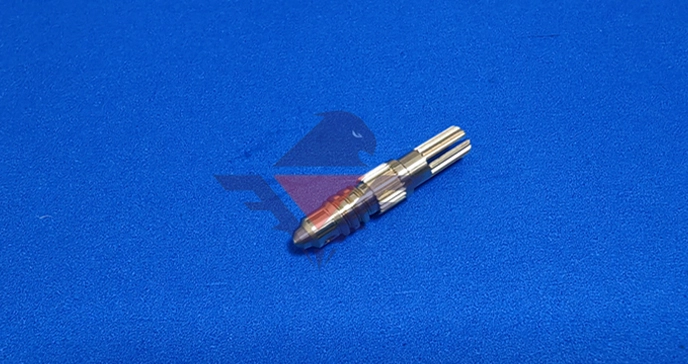


In all industries, manufacturing engineers are constantly evaluating different production technologies in the pursuit of efficiency, performance, and reliability. While 3D printing can be leading the news for prototyping, and traditional CNC machining provides a wide range of capabilities, there is one niche process that is the clear standard bearer for producing high volume, precision, complex, miniature components: Swiss Screw Machining.
For designers and specifiers of parts in the automotive, medical, and commercial applications; understanding the engineering fundamentals and applications of this niche technology is more than academic, it is necessary for making informed design and sourcing decisions which ultimately affect product quality, and cost.
Breaking Down the Swiss Screw Machine: A Mechanical Engineering Success
At the most basic level, the Swiss-type lathe is an answer to the most basic physical problem, that of deflection due to tool pressure. When machining long slender bar stock on a conventional lathe, the cutting pressure can cause the workpiece to deflect, which manifests as poor tolerance and surface finish results.
The Swiss machine fixes this in two ways:
The Guide Bushing: The hardened bushing supports the bar stock just a few mm from the cutting tool. This nearly eliminates deflection, and thus provides exceptional precision over the length of the component, even at a high feed rate.
The Sliding Headstock: The headstock advances the bar stock axially (Z-axis) through the guide bushing, while the cutting tool(s), that are positioned radially, operate in the X and Y axes. The separation of this movement provided precision, beyond measure.
Modern CNC Swiss screw machining centers have transformed into manufacturing machines. Including the use of live rotating tools, secondary spindles, and back-working units, they are able to turn, mill, drill, cross tap, and thread all in one continuous process. The ability to produce finished comped swiss turned parts in a single operation reduces the accumulation of errors and cycle times.
Application in Automotive and Industrial Systems: Where Precision Meets Performance
The value of precision swiss machining is a demonstration in extreme environments. A reputable swiss machining manufacturer does not merely make parts. They are integral to building systems in which failure is, not, an option.
Automotive Powertrain & Safety. From a flame hardened fuel injector components to a sensor housing for a transmission, and arguably the most important screw machine parts in anti-lock braking and steering applications. These swiss screw machine parts must endure for thousands of hours of grueling conditions.
Medical Device Development. The medical industry is a natural fit for swiss machining due to the requirements for biocompatible material, extreme cosmetic surface finish and complex geometries. Medical screw machining is accomplished through components such as bone screws or surgical instrument shafts and implant connectors needing the necessary precision and cleanliness.
Industrial Automation & Robotics: The connectors, sensor bodies, and actuator shafts that drive modern automated equipment and robotics are derived from the repeatability and reliability of Swiss machine products. High-volume screw machine parts provide a seamless solution for production lines worldwide.
When searching for a screw machine shop or screw machine products provider, engineers should seek to engage a partner demonstrating full-service screw machine services including material selection, design for manufacturability (DFM), and full secondary processing – all offered as part of a turnkey solution by respected and trusted screw machine parts manufacturers in the industry.
The Falcon CNC Swiss Advantage: Engineering as Partner
At Falcon CNC Swiss, we offer custom swiss screw machining as an engineering partner to our clients. Our state-of-the-art multi-axis Swiss-type lathes allow us to go from a standard swiss screw machine product to providing custom swiss screw machining solutions of high complexity.
Our engineers don’t just read the blueprints; they consider the blueprints for manufacturability. They recommend changes to designs (such a slight radius, tolerance, or material) to improve part performance, attributed to reliability, while also achieving significant cost savings upon project ending without impacting overall design intent. This belief takes from vendor to partner, and ultimately an extension of your engineering team.
Conclusion: Specify with Confidence
As mechanical devices and the performance criteria continue to be complicated and demanding, Swiss machining services are a fundamental manufacturing solution. For engineers designing the next generation of automotive, industrial, and medical devices, choosing a Swiss screw machining provider as your partner is strategic.
It guarantees the outcome of the most challenging, high-volume component at the greatest precision, expediting consistency, and efficiency to ensure that final assembly functions as designed every time.
Do you want to see how a partnership with engineering can optimize your next design? Learn about our Swiss Screw Machining capabilities, and speak with our engineering team today.