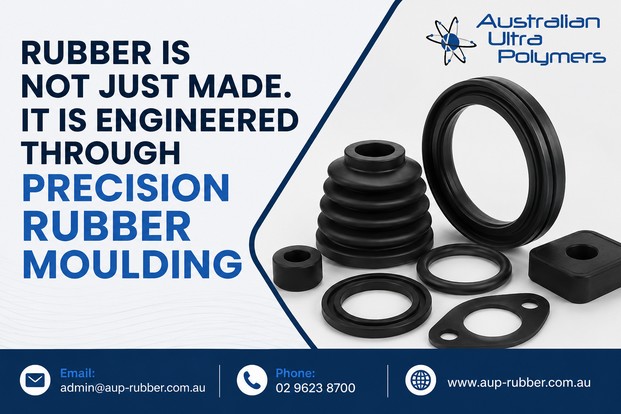


Most people see rubber as a finished product — a seal, gasket, lining, roller, or industrial component. What they often do not see is the science, engineering, and precision behind every product. High-quality rubber products are not simply manufactured; they are carefully engineered to perform under demanding real-world conditions. That is where rubber moulding and rubber compounding play a critical role.
From industrial machinery to automotive applications, the success of any rubber component depends on the quality of the compound, the expertise of the rubber compounders, and the precision of the moulding process. Every stage influences durability, flexibility, heat resistance, chemical stability, and long-term performance.
It Starts Before the Shape: The Science of Rubber Compounding
Before rubber can be moulded into a finished product, it must first be engineered at a molecular level. This process is known as rubber compounding. Rubber compounding is not simply about mixing materials together. It is the process of designing a rubber formulation that delivers the exact properties required for a specific application.
Industrial rubber products are exposed to challenging environments every day. Some components must withstand extreme temperatures, while others must handle constant pressure, chemicals, UV exposure, oils, abrasion, or repeated mechanical stress. Each of these requirements is controlled during the compounding stage.
Professional rubber compounders carefully select raw materials, fillers, curing agents, stabilisers, and additives to achieve the right balance of properties. The quality of the compound determines how the rubber will perform throughout its lifespan.
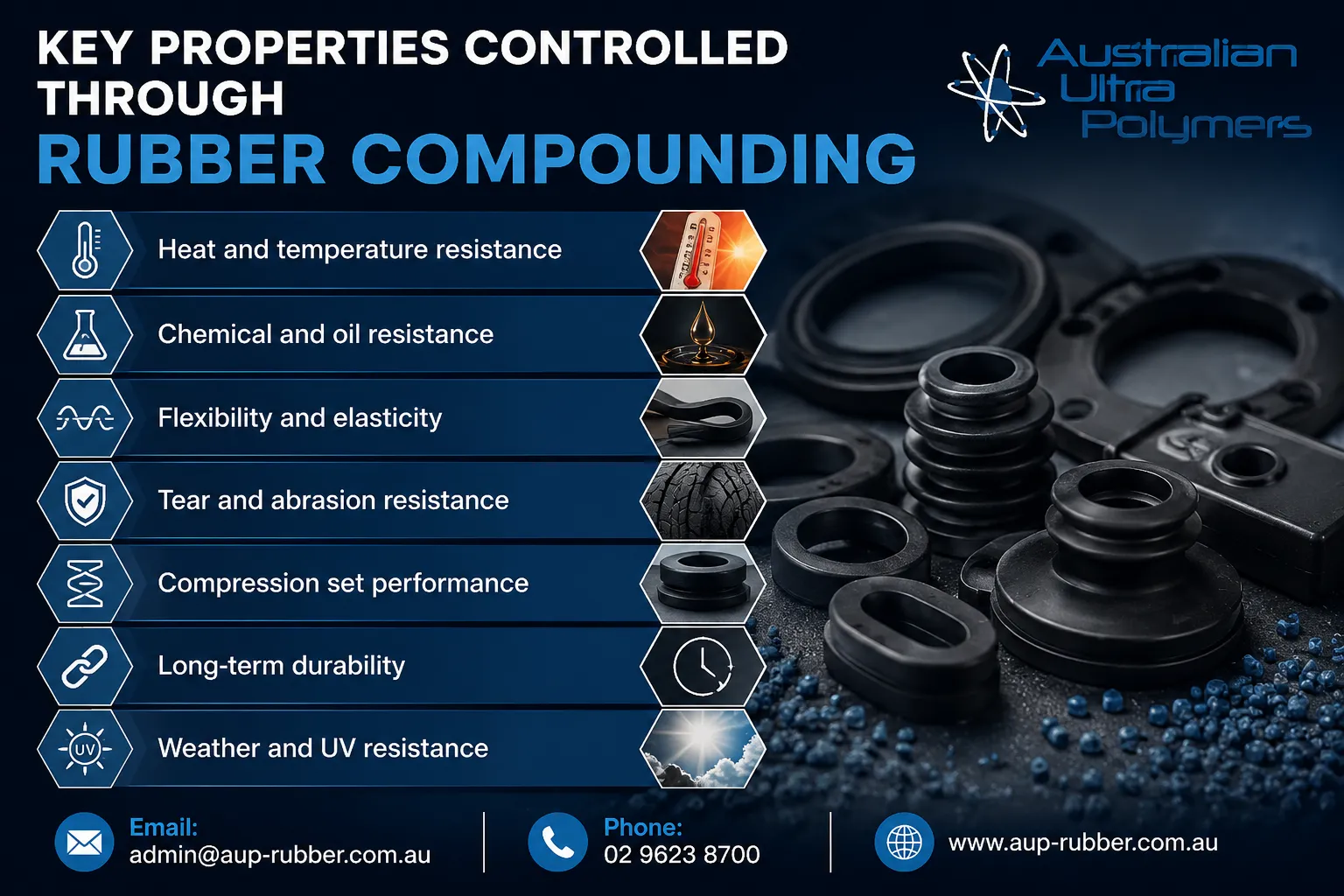
Key properties controlled through rubber compounding include:
- Heat and temperature resistance
- Chemical and oil resistance
- Flexibility and elasticity
- Tear and abrasion resistance
- Compression set performance
- Long-term durability
- Weather and UV resistance
Without precise rubber compounding, even the best moulding process cannot produce reliable industrial rubber components.
The Transition From Material to Form
Once the compound has been developed, the next stage is rubber moulding. This is where engineered rubber materials are shaped into functional industrial products.
Rubber moulding is far more than a simple manufacturing process. It requires precision tooling, carefully controlled temperature and pressure settings, curing accuracy, and consistent quality management throughout every production cycle.
The purpose of rubber moulding is not only to create the final shape but also to ensure that every component performs consistently under real operating conditions. Even a minor variation during moulding can affect durability, dimensional accuracy, flexibility, or overall product reliability.
Modern rubber moulding processes are designed to deliver:
- Precise dimensions and tolerances
- Uniform stress distribution
- Consistent material density
- Improved product strength
- Reduced production defects
- Reliable repeatability across large production volumes
This level of precision is essential in industries where performance and safety cannot be compromised.
Why One Formula Never Fits Every Industry
One of the biggest misconceptions in manufacturing is that all rubber materials are the same. In reality, there is no universal rubber formula.
Different industries require completely different performance characteristics. Automotive applications often demand excellent heat resistance and durability. Industrial sealing applications require strong chemical resistance. Mining and heavy machinery components must withstand constant abrasion and high mechanical stress. Consumer products may require flexibility, softness, and safety compliance.
This is why experienced rubber compounders create custom formulations tailored to the exact requirements of each application.
Examples include:
- Automotive components requiring heat and oil resistance
- Industrial seals needing chemical stability
- Mining equipment demanding abrasion resistance
- Food-grade applications requiring compliance and hygiene standards
- Construction materials exposed to UV and weather conditions
- Manufacturing components requiring long fatigue life
Custom rubber compounding allows manufacturers to engineer products that perform reliably in demanding environments rather than relying on generic, off-the-shelf materials.
What Happens When Quality Is Compromised?
When rubber is poorly compounded or incorrectly moulded, the consequences become visible very quickly.
Low-quality rubber products may experience:
- Premature cracking
- Loss of flexibility
- Swelling from chemical exposure
- Surface wear and abrasion
- Compression failure
- Reduced lifespan
- Production downtime
- Increased replacement costs
For industries that depend on reliable equipment and continuous operations, poor-quality rubber components can create expensive operational problems.
This is why businesses increasingly work with trusted rubber compounders that focus on performance, quality control, and precision engineering.
Technology Is Improving Rubber Manufacturing
Modern rubber manufacturing combines material science with advanced production technology. Today’s rubber compounding and rubber moulding processes rely on:
- Computer-controlled mixing systems
- Advanced rubber calendering equipment
- Precision moulding technology
- Strict batch consistency controls
- In-house quality testing
- Continuous performance evaluation
These technologies help manufacturers produce consistent, high-performance rubber products at scale while reducing waste and improving efficiency.
The combination of advanced rubber moulding systems and precision rubber compounding allows industrial manufacturers to meet exact engineering specifications across multiple industries.
Efficiency Is Built Into the Process
An efficient manufacturing process is not only about production speed. It is also about consistency, reliability, and reducing operational risk.
Professional rubber compounders and moulding specialists help businesses:
- Reduce material waste
- Improve product consistency
- Shorten production cycles
- Maintain strict quality standards
- Lower long-term maintenance costs
- Improve operational reliability
By investing in high-quality rubber compounding and moulding solutions, businesses can improve productivity while reducing the risk of component failure.
Behind Every Rubber Product Is Precision Engineering
Even the smallest rubber component is the result of multiple engineering decisions made during the compounding and moulding stages.
What may appear to be a simple gasket, seal, strip, or industrial part is actually the outcome of:
- Careful material selection
- Advanced rubber compounding
- Precision rubber moulding
- Controlled curing processes
- Detailed quality testing
- Continuous performance evaluation
This hidden engineering process is what ensures consistent product performance in demanding industrial environments.
The Precision Behind Every Rubber Formulation
The smallest detail in rubber compounding can make the biggest difference in performance. Every ingredient added by experienced rubber compounders serves a specific purpose.
Some ingredients improve flexibility, while others enhance heat resistance, abrasion resistance, tensile strength, or chemical stability. Proper formulation ensures the rubber maintains performance even after years of exposure to harsh operating conditions.
Without accurate compounding, moulded rubber products may fail long before their intended service life.
This is why industrial manufacturers rely on experienced rubber compounders that understand both material science and real-world operating conditions.
Forming That Determines Ultimate Performance
Once the compound is finalised, rubber moulding transforms it into precise, functional industrial parts.
To achieve the correct finish, moulding requires accurate timing, controlled pressure, and carefully managed temperatures. Skilled manufacturers ensure every moulded component meets strict quality standards while maintaining dimensional accuracy and performance consistency.
When advanced rubber moulding is combined with high-quality rubber compounding, the result is a durable and reliable product designed for long-term industrial use.
About AUP Rubber
Australian Ultra Polymers (AUP Rubber) is one of Australia’s trusted manufacturers specialising in rubber compounding, rubber moulding, rubber mixing, and custom rubber engineering solutions. With more than 25 years of industry experience, AUP Rubber delivers high-performance industrial rubber products designed for demanding applications across Australia.
AUP Rubber operates advanced rubber mixing lines, precision moulding systems, and in-house quality testing facilities to ensure every product meets strict quality and performance standards. The company manufactures custom rubber compounds, moulded components, rubber sheeting, strips, slabs, and engineered industrial rubber solutions tailored to specific operational requirements.
As experienced rubber compounders, AUP Rubber works closely with clients to develop custom formulations that match real-world performance needs, including heat resistance, oil resistance, chemical stability, weather resistance, flexibility, and abrasion resistance.
Why Choose AUP Rubber?
Businesses across Australia choose AUP Rubber because of its technical expertise, manufacturing consistency, and commitment to quality.
1. Advanced Rubber Compounding Expertise
AUP Rubber specialises in custom rubber compounding for industrial applications. Their team develops tailored formulations using materials such as EPDM, Nitrile, Neoprene, Butyl, Silicone, HNBR, Viton, Natural Rubber, and more.
2. Precision Rubber Moulding Solutions
The company provides high-quality rubber moulding services designed to meet demanding industrial specifications. Every component is engineered for consistency, dimensional accuracy, and long-term durability.
3. ISO-Certified Quality Standards
AUP Rubber follows strict quality systems and manufacturing controls to ensure reliable performance and product consistency.
4. Custom Engineering Support
Their experienced team works closely with engineers, manufacturers, and procurement teams to create custom rubber solutions based on real operating conditions.
5. Australian Manufacturing Advantage
As a 100% Australian-owned manufacturer, AUP Rubber provides faster turnaround times, local support, reliable supply chains, and dependable customer service.
Benefits of Working With Experienced Rubber Compounders
Choosing experienced rubber compounders offers significant long-term advantages for industrial businesses.
Benefits include:
- Improved product reliability
- Longer equipment lifespan
- Reduced maintenance costs
- Better resistance to harsh environments
- Lower downtime and replacement frequency
- Consistent product quality
- Greater operational efficiency
- Custom-engineered material performance
By partnering with an experienced company like AUP Rubber, businesses gain access to engineered rubber solutions designed specifically for their operational needs.
Final Words
The quality of any rubber product depends on the expertise behind its formulation and manufacturing. Rubber compounding and rubber moulding are not simply production processes — they are precision engineering disciplines that directly influence product performance, durability, safety, and reliability.
Whether you require industrial seals, custom moulded components, rubber sheeting, or specialised engineered compounds, working with experienced rubber compounders ensures consistent long-term performance.
AUP Rubber stands out as a trusted Australian manufacturer with extensive expertise in rubber moulding, rubber compounding, and industrial rubber engineering. With advanced production systems, ISO-certified quality processes, and more than 25 years of experience, AUP Rubber delivers reliable solutions built for demanding industrial environments.
For businesses looking for dependable rubber solutions that combine durability, precision, and performance, AUP Rubber remains a trusted industry partner.