
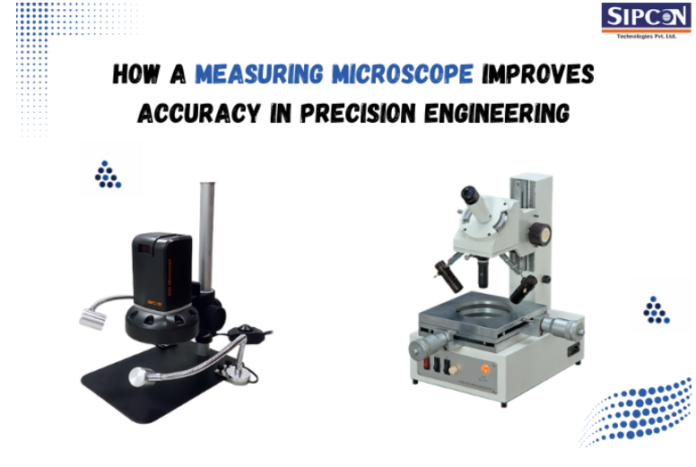


Industries, including automotive, aerospace, electronics, and toolmaking, rely heavily on precision engineering as their foundation. Even a minor change in size can cause serious problems with how well a product works. Advanced Optical Measuring Tools, such as Measuring Microscopes, are used to measure objects with high accuracy (in microns). Measuring Microscopes have gained prominence in places like Pune, Bengaluru, and Gurugram, all three of which are some of the biggest Manufacturing Hubs in India, and are necessary for maintaining the internationally recognised quality standards.
Understanding the Role of a Measuring Microscope
A measuring microscope is a high-precision optical instrument designed to measure small components, intricate profiles, and fine geometries with exceptional accuracy. Unlike conventional microscopes that focus mainly on magnification, a measuring microscope integrates precision scales, digital readouts, and micrometer stages to deliver exact dimensional values. This makes it ideal for inspecting components where tolerances are extremely tight something increasingly demanded in “Make in India” and export-oriented manufacturing.
By combining optical clarity with mechanical precision, a measuring microscope allows engineers to measure lengths, angles, radii, hole diameters, and thread profiles without physically touching the component, reducing the risk of deformation.
Enhancing Dimensional Accuracy in Precision Engineering
One of the biggest advantages of using a measuring microscope in precision engineering is its ability to eliminate human estimation errors. Traditional tools like vernier calipers or gauges depend heavily on operator skill. In contrast, measuring microscopes provide digital measurements that are highly repeatable and traceable to standards.
For example, in die and mold manufacturing—a sector deeply rooted in Indian industrial clusters—components often require accuracy within a few microns. A measuring microscope ensures that every edge, contour, and feature matches the design specifications before the component moves to the next production stage.
Toolmakers Microscope: A Specialized Advantage
A Toolmakers Microscope is a specialized type of measuring microscope widely used in tool rooms and inspection labs. It is particularly effective for measuring complex tool geometries, cutting edges, gear profiles, and punch-and-die components. Precision engineers rely on Toolmakers Microscopes to verify tool accuracy during both development and maintenance stages.
In industries where CNC machines and EDM processes are common, Toolmakers Microscopes help bridge the gap between design intent and manufactured reality. They allow engineers to inspect tools under magnification while simultaneously measuring critical dimensions, ensuring tools perform consistently over long production runs.
Improving Quality Control and Process Reliability
Accuracy in precision engineering is not limited to final inspection—it is deeply connected to process control. A measuring microscope supports in-process inspection, helping manufacturers detect deviations early. This proactive approach reduces scrap rates, saves material costs, and improves overall productivity.
With increasing competition from global markets, Indian manufacturers are adopting advanced metrology solutions to meet ISO and international quality standards. Measuring microscopes play a vital role in audits, documentation, and validation processes, making them indispensable in quality control laboratories.
Non-Contact Measurement for Delicate Components
Many precision-engineered components, especially in electronics and medical device manufacturing, are extremely delicate. Physical contact during measurement can damage surfaces or alter dimensions. Measuring microscopes offer non-contact measurement, preserving component integrity while still delivering accurate results.
This capability is particularly valuable in industries producing micro-components, PCBs, and precision assemblies, where even minimal force can cause defects.
Integration with Modern Manufacturing Practices
Modern measuring microscopes often come with digital displays, camera systems, and software integration. This allows easy data recording, image analysis, and report generation—features that align well with Industry 4.0 and smart factory initiatives gaining traction in India.
Engineers can store measurement data for traceability, compare results over time, and improve process optimization. This data-driven approach strengthens decision-making and ensures consistent product quality.
About Sipcon Instrument
Sipcon Instrument is a trusted name in precision measurement solutions, offering high-quality measuring microscopes and Toolmakers Microscopes designed for industrial and laboratory use. Known for their accuracy, durability, and user-friendly design, Sipcon Instruments supports a wide range of industries, including automotive, aerospace, electronics, and tooling. Their instruments are engineered to meet international standards while addressing the practical needs of Indian manufacturers, making them a reliable partner in precision engineering and quality assurance.
Conclusion
In precision engineering, accuracy is not optional—it is essential. A measuring microscope significantly enhances measurement reliability, reduces errors, and supports strict quality requirements. With specialized solutions like the Toolmakers Microscope and dependable manufacturers such as Sipcon Instruments, industries can achieve consistent precision, improve productivity, and compete confidently in both domestic and global markets.